Saturday, January 30, 2010

7. People Love an Easy Walk

In villages of the old world, people walked everywhere, to work, to market or store, to school, to church, and to eat with their friends. They had contact with others along the way. Easy physical contact with other people kept them from feeling isolated. Historically, people not only knew their neighbors but everyone else in town, the simple result of walking their village.


Image above shows children walking home from school in an urban setting.
What happened to the fun or drama of chance meetings along the way? What happened sudden rainstorms, the wind in your hair or the pebble in your shoe?
These issues are truly important to consider and re-introduce to the built environment.


Image above: Sentimental yes, but learning to find their way in life!

Cycle Paths
When the school or library is just too far to walk to, bicycles are great and take up very little space.
It is so much cheaper and easier to provide for cycle paths than for cars. Get a copy of "Cycle-Friendly Infrastructure: Guidelines for Planning and Design".


Note how narrow an effective a cycle path needs to be.

But, people love cars too!
Yes, cars are fun to drive. Some are beautiful to look at. Men of the world have fallen in love with seductively curvaceous sheet metal that their wives will let them keep as an allowable mistress. This is a personal favorite, the Alfa Romeo Spider. Yes!


The exhilaration of speed is an added bonus. But tell me where can I still find a winding country road that is still fun to drive without the fear of being flagged down by a state trooper? Perhaps in the countryside just outside the village?
Cars represent personal mobility. One can get from one place to another choosing ones exact destination, the range and speed. One can carry items too large to carry by hand. Automobiles also represent personal expression. This is a key element of how drivers choose their vehicles. In a world where home ownership is out of reach for many people, the automobile becomes the biggest investment one will personally make. The desire to have the car reflecting one's personality through color, design or brand, is a near-inevitable result: the sense of personal freedom and independence. Even though there is increasing pressure on auto makers to provide smaller electric or hybrid vehicles, the need to buy and use cars is not likely to disappear.
Before we look at how cars should be accommodated in new projects, let us next examine just how bad planning has let automobiles destroy village life.

Conclusions:
1.Provide your development with a pedestrian core where even small children are safe to walk.
2. Provide cycle tracks to more distant locations.

Images: 1)emergentstructures 2)thedailygreen 3)everydaycycling.com 4)cars4fast

Friday, January 29, 2010

6. The Proximity Circle - A Great Lesson from Mykonos

Finding protection in a village setting meant that living units had to be built in close proximity to each other. The term “village” simply denotes a collection of villas, whereas the term “urban village” means that the spaces for all the other functions necessary for communal living are included and provided for. The denser the fabric of the buildings that make up a village, the closer the available functions that can be placed are within an easy walking distance from home. People love walking short distances. Think about the after dinner stroll looking into shop windows, or a promenade on the town pier or village green.


World famous Mykonos, in Greece where everything is within walking distance. The most cosmopolitan of all Greek islands, it attracts so many visitors from all over the globe, including large numbers of artists and intellectuals.


The proximity circle is so simple and yet so important and oh so easy to be overlooked!
All the benefits of living in a true urban village is based on the close proximity of working, eating, buying, selling, playing, schooling and assembly or meeting spaces to your home.


Successful villages do not break the proximity circle by leaving out even one of the above components. Henry Ford simply did not understand or even care that his wonderful invention would enable the wide-spread destruction of the true urban village as a building block of our civilization. Destruction of the proximity circle has resulted in isolation and loneliness for millions of people who are trapped in city suburbs. We were born with legs and not with wheels. Walking always was and should still be the measure of proximity and the way to build what people love..The easy walk and not the easy drive is the golden rule!


My painting called "View of Mykonos".
See others at http://arnogallery.com/


My painting "Mykonos Flower Seller"


My painting "Mykonos Fisherman"

A Great Lesson from Mykonos (and of all true villages)
The easy walk and not the easy drive is the golden rule!Publish Post
Place every facility within a short and easy walking distance from home.

Thursday, January 28, 2010

5. Village Walls and Towers

A true urban village lifestyle is the way most people prefer to live. As soon as groups of primitive people found themselves in peaceful accord, they built a village together. Whether the agreement between them was verbally communicated or not, it brought a measure of safety and  peace. People agreed to stop fighting, to protect each other by banding together against a common enemy and to work together on shared objectives. They agreed to trade skills, agreed to market and trade produce at a common marketplace or in speciality shops. Sometimes the “peace” they sought came about by accepting the protection of a leader in return for work and subservience. Even an agreement to be subservient brought a measure of peace which in turn, brought an opportunity to specialize and to profit.


In ancient cultures the safety wall was built first as here around Takht-e Suleyman in Azerbaijan.


The solid walls of Monteriggioni in Italy provide a sense of protection as do the tall walls of St. Malo in France below.


The tall towers of San Gimignano were built by warring families within the same village. They would hurl stones and even burning oil from their lofty perches down on anyone who came too close. In society the taller your tower,the greater your power and prestige. Paris has its Eiffel tower, Venice has its Campanile and Mr Trump has his Trump Tower. Even small villages have their towers, each one a symbol of prestige and power.


Tower Power and Prestige. 
Does the image below look familiar? Yes, it's all been done before.


Build your own towers, your villagers will love them and your competitors will hate and sadly perhaps even go so far as to attack them! 


Conclusions;
1. Furnish your development with a sense of security, symbolized by an entry arch or gateway.
2. Provide a sense of power and prestige by making even one structure way taller than the others.

Images: 1)latis-exeter 2)chaffeurs-italy 3)corsaires-malounis 4)Panoramio 5)Andy B 6)ecicalla77 7)Sonyfoto

4. Earth, Air, Fire and Water

Many philosophies have used a set of archetypal elements that consist of the simplest essential parts with which all things are made.The Greek Classical Elements (Earth, Water, Air, Fire, and Aether) persisted throughout the Dark Ages and into the Renaissance, greatly influencing European thought and culture.

In the hilltop village of Eze in Provence, the drama of the play between the elements easily spring to mind.
One classic diagram (below) has one square inscribed in the other, with the corners of one being the classical elements, and the corners of the other being the properties. The opposite corner is the opposite of the these properties, "hot - cold" and "dry - wet". Of course, some of these qualities hold true in a Mediterranean climate; those living further north would be a lot less likely to describe air as being hot, or earth as being dry. Images are from the Hotel Chateau Eza.


Eze is perched high on a hill with a spectaurar view of the Mediterranean. It is without doubt one of the world's unique and beautiful places. The sun burns down from the sky, Often airy clouds go swirling by. Narrow pedestrian lanes are hemmed in by towering stone walls only to reveal explosive views of the ocean far below.


Stone walls and lanes embrace pedestrians, holding them safely bound to terra firma. Just a few building materials create a rich and varied maze of village spaces, leaving the visitor breathless and spellbound.


Finally and out of breath, you are there; at the Hotel Chateau Eza. And what's more, it's time for lunch!


Ah, our table is ready!


Where does the sky end and the ocean start? The climbing pedestrian is finally released from the earthen maze below and lifted up half-way to heaven.


Lessons from Eze:
1.Use the classical elements of earth, air, fire and water to provide drama to your projects.
2. Keep the suspense going by using narrow lanes, archways and coutyards.
3. Just a few basic building materials can be masterfully woven into visually rich and varied environment.


Images:
1)Hotel Chateau Eza 2)Andre Lubeck 3)Wikipedia 4)Allia.5)bue_quartz 6)jeffwilcox 7)Dario Pozzi.8)Bluguia_Pabl0 9)Sven Lindner 10)Geevee

3. Lessons from Positano

I mentioned how my love of villages started with a visit to Positano by my parents. Since then I did of course visit there myself and was not disappointed.

Positano's natural beauty simply takes ones breath away; the sea, the sky, the mountains, the simple terraced houses and of course, the bougainvillea!


What makes this so very place special? The amazing views and ever changing mood visible from every corner. The natural setting of a town is its most impressive characteristic. Just think of the world's most beautiful cities, Rio de Janiero, Cape Town and Hong Kong. Positano is a delicate venacular masterpiece set in a dazzling setting.


Positano is built like an amphitheater such as this one in Arles, France.
Terraced houses all look down, focussed on a stage that is made up of the church piazza, fishing harbour, beach and the sea and boats beyond. People  love to watch life in action. No one in Positano is excluded from being in touch the daily performance of work and leisure down below. Every villager is a part of the activities from a window or porch of his or her hillside home.


Conclusions: 
1. When choosing a site to build on, nothing beats natural beauty.
2. Design buildings to form curved terraces so that people can look down on a "stage" of social activities.

Images by:
1.Amalfitana, 2.Alessandro Staffiero,3.Chapps,4.Raniero Tazzi,5.Ita26b,6.Marcus,7.Amalfitana,8.http2007.

2. People love a village!

When I was a teenager, my parents returned from a European vacation with a 16 mil. movie my dad had shot of a beautiful fishing village called Positano on the Amalfi coast of Italy ; see image below. Unbeknowns  to me at the time it turned the interest of my young mind to places and spaces of beauty, what was special about them and what made them destinations that people would travel for thousands of miles to visit! I now head a team of architects, engineers, planners, “green” consultants, landscape architects,  interior designers and artists that design new villages!
Since those early beginnings, I have visited many beautiful towns, enjoyed them, studied them, analyzed them as an architect and painted them! - see my paintings at arnogallery.com


People love villages. How sad to drive by an ugly old apartment building in the worst part of town and see the name on the sign, yes.....you’ve guest it, Positano!


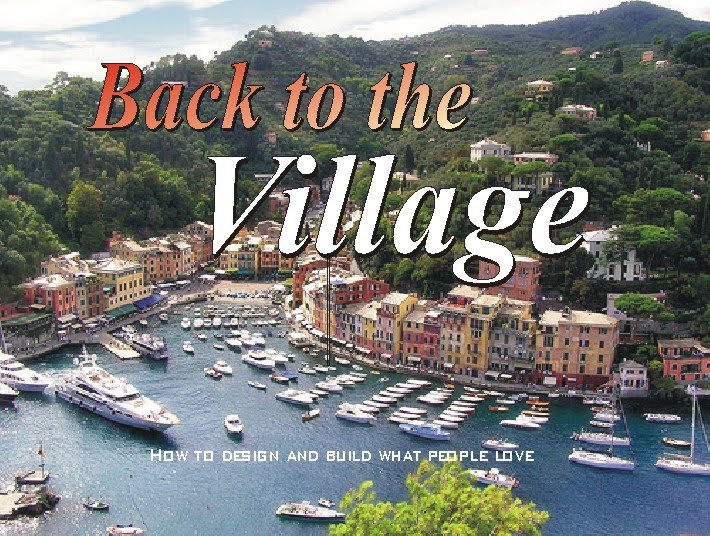
The most beautiful old villages in the world have become tourist destinations. Villages such as Portofino above,
Mykonos in Greece, Ambleside in England, Brugge in Belgium or the villages of  Vermont get hundreds of thousands of visitors each year. They serve as models of environmental beauty, places to stroll around and linger to recapture the sense of “It's great to be alive!” Some countries now have lists of villages for travelers to visit, see for instance “The Most beautiful villages in France” at http://www.les-plus-beaux-villages-de-france.org/
Many coffee table books now feature essays and photographs of idyllic towns and villages.

Villages come in many shapes and sizes. There are urban villages, sub-urban villages, rural villages, agricultural
villages, resort villages and sports villages. Now there are “eco” villages and even vertical villages. Even large
cities contain true urban neighborhoods that were once separate villages. New York's Manhattan has Greenwich Village, Chinatown, Little Italy, Soho, Noho etc.

Images: 1)Amalfitana   2)Ben

1. Introduction

How do we improve the quality of our lives? This blog is about identifying what people love about the built environment, regardless of architectural style. By tracing how communities were structured over eons of time and with good reason,, I aim to show how to restore these time proven patterns to our new building projects.


Image: Pienza in Italy. The very first fully planned Renaissance village.
Although the examples used come mostly from the USA and Europe, the patterns are observable in the villages of many cultures, from the orient to the occident. In addition, the important  issue of “green” technology is addressed and supported. I suggest we use these patterns because people matter.
Very soon, dwindling traditional resources and rising gas prices will force people everywhere to think “outside the box”. By applying the principles outlined here, you will be ahead of the pack.
Giving people what they like, love and makes sense will translate into all round profitability and benefit society at the same time. It is a win-win situation for all concerned in the development process, investors, developers, buyers and tenants.

Images: 1)Luana58
                                         Publish Post