Showing posts with label Travel. Show all posts

Thursday, January 28, 2010

4. Earth, Air, Fire and Water

Many philosophies have used a set of archetypal elements that consist of the simplest essential parts with which all things are made.The Greek Classical Elements (Earth, Water, Air, Fire, and Aether) persisted throughout the Dark Ages and into the Renaissance, greatly influencing European thought and culture.

In the hilltop village of Eze in Provence, the drama of the play between the elements easily spring to mind.
One classic diagram (below) has one square inscribed in the other, with the corners of one being the classical elements, and the corners of the other being the properties. The opposite corner is the opposite of the these properties, "hot - cold" and "dry - wet". Of course, some of these qualities hold true in a Mediterranean climate; those living further north would be a lot less likely to describe air as being hot, or earth as being dry. Images are from the Hotel Chateau Eza.


Eze is perched high on a hill with a spectaurar view of the Mediterranean. It is without doubt one of the world's unique and beautiful places. The sun burns down from the sky, Often airy clouds go swirling by. Narrow pedestrian lanes are hemmed in by towering stone walls only to reveal explosive views of the ocean far below.


Stone walls and lanes embrace pedestrians, holding them safely bound to terra firma. Just a few building materials create a rich and varied maze of village spaces, leaving the visitor breathless and spellbound.


Finally and out of breath, you are there; at the Hotel Chateau Eza. And what's more, it's time for lunch!


Ah, our table is ready!


Where does the sky end and the ocean start? The climbing pedestrian is finally released from the earthen maze below and lifted up half-way to heaven.


Lessons from Eze:
1.Use the classical elements of earth, air, fire and water to provide drama to your projects.
2. Keep the suspense going by using narrow lanes, archways and coutyards.
3. Just a few basic building materials can be masterfully woven into visually rich and varied environment.


Images:
1)Hotel Chateau Eza 2)Andre Lubeck 3)Wikipedia 4)Allia.5)bue_quartz 6)jeffwilcox 7)Dario Pozzi.8)Bluguia_Pabl0 9)Sven Lindner 10)Geevee

2. People love a village!

When I was a teenager, my parents returned from a European vacation with a 16 mil. movie my dad had shot of a beautiful fishing village called Positano on the Amalfi coast of Italy ; see image below. Unbeknowns  to me at the time it turned the interest of my young mind to places and spaces of beauty, what was special about them and what made them destinations that people would travel for thousands of miles to visit! I now head a team of architects, engineers, planners, “green” consultants, landscape architects,  interior designers and artists that design new villages!
Since those early beginnings, I have visited many beautiful towns, enjoyed them, studied them, analyzed them as an architect and painted them! - see my paintings at arnogallery.com


People love villages. How sad to drive by an ugly old apartment building in the worst part of town and see the name on the sign, yes.....you’ve guest it, Positano!


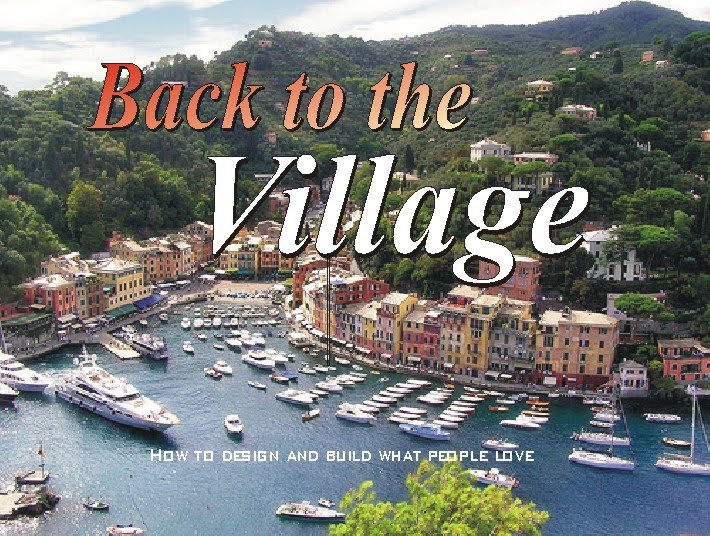
The most beautiful old villages in the world have become tourist destinations. Villages such as Portofino above,
Mykonos in Greece, Ambleside in England, Brugge in Belgium or the villages of  Vermont get hundreds of thousands of visitors each year. They serve as models of environmental beauty, places to stroll around and linger to recapture the sense of “It's great to be alive!” Some countries now have lists of villages for travelers to visit, see for instance “The Most beautiful villages in France” at http://www.les-plus-beaux-villages-de-france.org/
Many coffee table books now feature essays and photographs of idyllic towns and villages.

Villages come in many shapes and sizes. There are urban villages, sub-urban villages, rural villages, agricultural
villages, resort villages and sports villages. Now there are “eco” villages and even vertical villages. Even large
cities contain true urban neighborhoods that were once separate villages. New York's Manhattan has Greenwich Village, Chinatown, Little Italy, Soho, Noho etc.

Images: 1)Amalfitana   2)Ben